
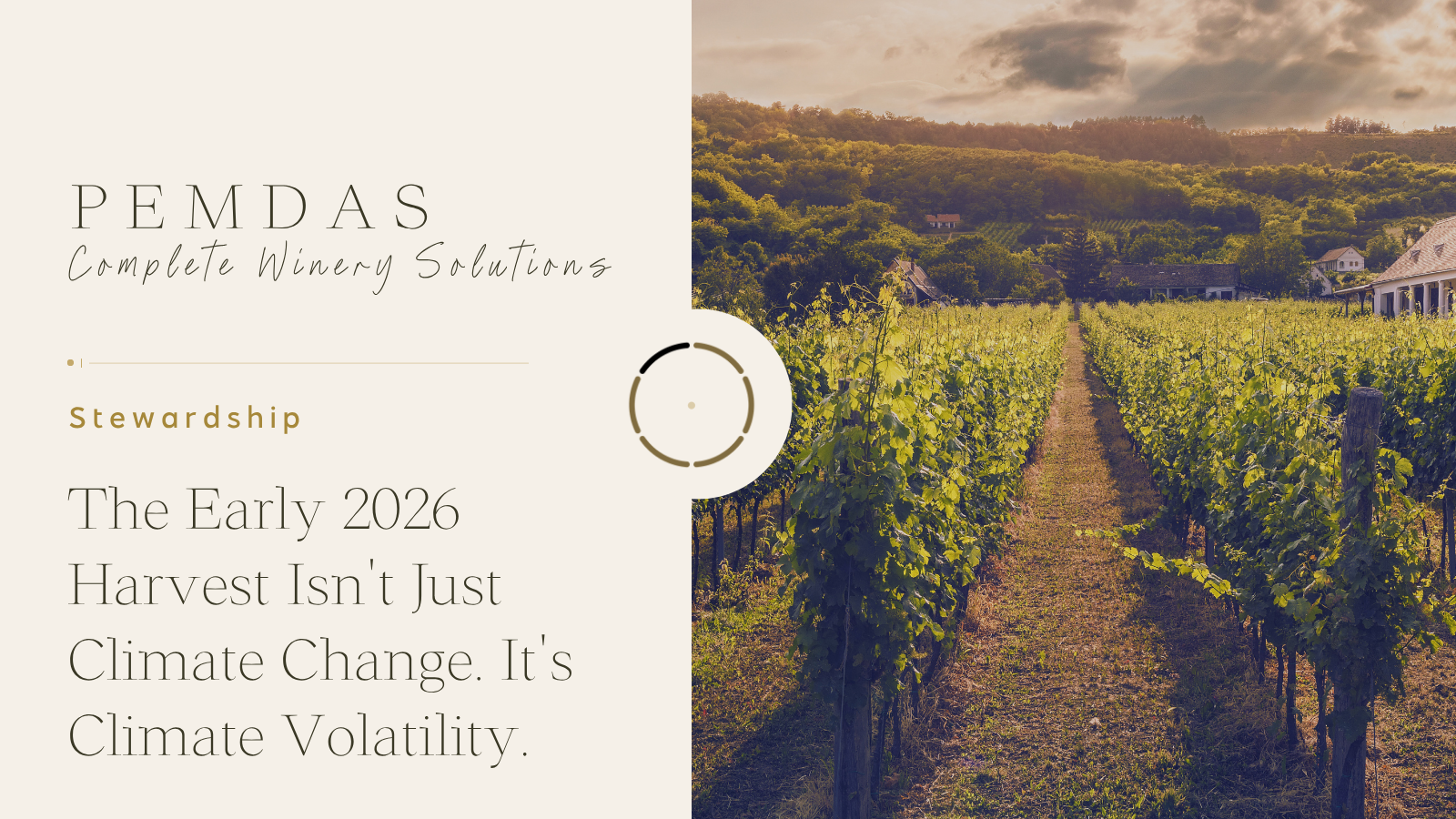
There is, for good reason, a lot of reporting right now on climate change and how it’s affecting the grape harvest. Everywhere you look, wine regions are experiencing harsher-than-normal conditions. It would be easy to write a post about how hot it is and stop there. But, I want to pick out something else: this is a story of climate volatility, not just heat.
A Cold Night in Bigfork, Montana
This hit home for me in 2022, when I was asked to evaluate a future winery, and existing vineyard in the Bigfork area of Montana. Two years earlier, in 2020, the growing season had been warm, and the owners felt good about what climate change might mean for grape growing that far north. But, climate change isn’t just hotter weather. It’s climate volatility. In that same warm year, Montana got a sudden, early, catastrophic cold event.
The weather through September and into early October 2020 stayed mild, highs in the mid-50s, with only two nights that dipped to freezing. Because of that, most of the vines across the state were still active in early October.
Then a storm moved through on October 23rd and 24th. By the morning of October 25th, temperatures across much of Montana had collapsed below zero. Potomac, east of Missoula, hit -29°F on the 25th, the coldest temperature recorded anywhere in the contiguous United States that early in the calendar year. It broke a 101-year-old record. Kalispell, right near Bigfork, fell to 0°F on the 26th, its coldest reading ever recorded for that date. The sap inside the not-yet-dormant vines froze suddenly and as it did, expanded. One winemaker described standing in the vineyard and hearing the vine after vine pop as they split open. The loss across the state was catastrophic. The following growing year turned out to be the warmest they’d had to date.
This year, Champagne’s vines endured a spring frost followed by record June heat. the same climate volatility that split vines open in Bigfork, MT, six years ago.
That’s what climate change looks like. Not a slow march toward a warmer, easier growing season. It’s a warm year that turns on a dime into a cold event severe enough to split the vines open, followed by the warmest year on record.
The Same Pattern, Six Years Later
That pattern is showing up again right now, in real time. This year vineyards around the world are being hammered by heat. Harvest is early almost everywhere. Both Sonoma County and Santa Barbara in California have started picking sparkling grapes. For Sonoma County it is the earliest wine grape harvest in at least forty years.
The story behind the early harvest in California isn’t a simple heat story either. A record-breaking heat wave in March triggered early bud break across the region. Then wind and rain moved in and disrupted pollination, leaving clusters shattered. Less fruit means less for the vine to ripen. So the grapes that did set reached maturity weeks ahead of schedule. Heat started the growing season early. Poor weather during fruit set lowered the crop and then the heat came back. All of these pushed in the same direction: less wine, earlier harvest. Harvest in California is close to a month early this year.
Record Heat Is Still the Headline
Western US growing regions are running 300 to 500 growing degree days above average this season, the equivalent of 20 to 30 days ahead of a normal pace. The western drought footprint has held at 91% since early June. Champagne is having the earliest harvest start in its recorded history. In Piedmont, growers say wines that used to reach 12% ABV are now landing closer to 14%. The expectation is that harvest will start at least a month early. Germany’s driest classification, Grosses Gewächs, is now flirting with 13.5% ABV in a region that is built around lower-alcohol, high-acid Rieslings.
Champagne’s own version of this is a two-part story, not a heat-only one. Growers there lost up to 40% of their early buds to spring frost, before the heat ever arrived. Then came a June heat wave with Bordeaux hitting 41.1°C (106°F), its hottest reading in 80 years. This pushed the region toward its earliest harvest ever, with growers estimating yields to be second lowest this century. Frost first, then heat. Two different kinds of extreme weather, in one growing season, in one region.
Climate Volatility Is the Real Story
It’s not just you. This is happening all over the world. Virginia had its worst frost in 20 years this spring, with losses running 20 to 90% by property. Ontario, Canada came through one of its coldest winters in recent memory, with confirmed bud damage in Niagara. Meanwhile British Columbia is under active drought and wildfire smoke conditions right now. Canberra had its worst November frost in 18 years, ahead of what trade press is calling Australia’s “three f’s” vintage: frost, fire, and flood in a single harvest. Central Otago, NZ swung from a dry winter to a wet spring, with crop-damaging wind gusts and a December cold snap that hit during flowering. Chile’s Ñuble region, home to the Itata Valley, saw catastrophic wildfires in January that killed 21 people. I could go on. Climate change is causing volatile, unpredictable weather across the globe.
Not Every Region Loses
Let’s be clear, some regions are getting a boom out of this, not a bust. Sparkling wine production is expanding in England as the climate there warms. It used to be considered too marginal for reliable ripening. Given time, the Willamette Valley may be as known for Syrah as it is for Pinot Noir. Montana could see more years that qualify as genuinely good growing years, years that help that young wine region survive and grow. Those are real upsides, worth naming alongside the losses.
But the upside doesn’t cancel out the volatility. The same instability that might hand Montana a good vintage is the instability that split those vines open in 2020. Heat and opportunity on one side, frost, hail, and flood on the other, in the same climate system, sometimes in the same region a few years apart.
What This Means for Your Vineyard
If you have a winery, or a vineyard, or you’re planning one, this isn’t a weather story you can file away as someone else’s problem. This is a call for a different kind of planning than what has been done in the past. There’s good news: the industry is already responding to it in different ways across the world.
Appellations are looking to new varieties and hybrids. Champagne authorized its first-ever disease-resistant hybrid grape, Voltis, with a ten-year trial window before regulators decide whether to expand it. Napa is another example. The climate is moving towards Napa becoming too warm for the world class wine that it built its reputation on, Cabernet Sauvignon. Vineyards in the valley are experimenting with Tempranillo, Alicante and Assyrtiko, among others.
Research institutions are studying how to manage heat in place, without changing what’s planted. At UC Davis’s Experimental Vineyard in Oakville, Dr. Kaan Kurtural runs trials on shade films and trellis and canopy systems. He’s also testing resilience across roughly 100 combinations of clones and rootstocks under simulated drought and heat stress. This June, UC Cooperative Extension ran a separate series of grower workshops across the Central Valley on building resilient crop systems for extreme and variable weather. That’s evidence this isn’t theoretical research sitting in a journal. It’s showing up as practical guidance growers are being handed right now.
A separate research effort is tackling smoke taint directly. Oregon State is leading a four-year, $7.65 million USDA-funded study with Washington State and UC Davis on how wildfire smoke affects wine grapes. Researchers have identified the compounds most responsible for smoke’s ashy flavor in wine and found that smoke enters fruit through leaves as well as skin. Early mitigation work already shows a pectin rinse can cut smoke carryover in finished wine And UC Davis is testing lower-cost air sensors that could put monitoring at the vineyard-block level.
None of these three responses is a complete answer on its own. New genetics move slowly, research takes years to reach commercial scale, and variety trials are still trials. But together they point at the same underlying idea: the wineries and regions that will handle this well aren’t the ones that guess the weather correctly. They’re the ones that build enough resiliency into what they’ve planted, how they farm it, and what they’re willing to try, so that a bad swing in either direction doesn’t take the whole vintage with it.
This is a significant departure from how the wine industry started and the tenets of how to choose which grapes to plant and how to farm them. Looking at your vineyard and winery now requires taking a long-term view. The climate is not going to be what it’s been, and to be successful, you have to build resilience into your business. That’s what surviving climate volatility looks like in practice.
If you have a vineyard, it’s time for you to look at what you can do in your vineyard to grow resiliency when you’re hit with volatile weather. Do you have other sources for grapes or wine, so a single bad weather event can’t undermine the revenue that drives your business? Have you mapped out what pivoting would actually look like? Can your business support it?
If you know you need to do something, but don’t have the staff or time, give me a call.

Genevieve Rodgers
Genevieve Rodgers has spent nearly 30 years helping wineries build sustainable, profitable businesses — from writing the first business plan to designing the production facility, launching DTC sales, and managing the brand.
Leave a Reply